How to choose between Notion and Obsidian: workflows, notes, and AI
Notion and Obsidian differ in how they organize, retrieve, and carry information forward. This article explains the thinking behind both tools.
Short Version
If a piece of information needs to move quickly into tasks, projects, collaboration, and automation, Notion is the better fit. It asks you to define location, status, and relationships earlier, which makes later retrieval and execution clearer.
If a piece of information is closer to long-term reading, research writing, early ideas, or unfinished thoughts, Obsidian is the better fit. It lets text stand on its own first, while categories and structure can grow later.
AI makes this difference more important. The more you want AI to help with execution, the more you need a structured system like Notion to define objects, permissions, and relationships in advance. The more you want AI to help you associate and reinterpret ideas, the more valuable Obsidian's text freedom becomes.
Notion Pros And Cons
Notion's friction appears as soon as you create a page. You need to find where that page belongs in the system. What is it? Where does it live? Does it relate to a task or a project? These questions appear early.
You can still start from a blank page and write everything there, but Notion's strength is also a constraint. It pulls you toward system building, so you often feel the pressure to place every piece of information properly.
That is also why Notion is useful. Notes can carry clear status, relationships, permissions, and operational boundaries. This structured classification helps you turn goals into actions faster, turn knowledge into reusable objects, and give teams a shared working standard.
That is why it is easy to build a CRM, project board, or content calendar in Notion. When Notion says everyone can create their own software, it is talking about arranging the same structured data through different views and dimensions. I turned this structured approach into my own Notion template, FLO.W 思流, which ties daily work together through projects, tasks, and notes.
In that sense, Notion has reached its "LEGO for Software" positioning. At least right now, I do not think any other mainstream product has done this as well.
Obsidian Pros And Cons
Obsidian is easier in a different way. A note can begin as nothing more than a note. Recording can come before classification, and possession can come before a system. You do not need to decide at the start whether this piece of information is a task, a project, a reference, or an outcome.
A simple folder structure can support most categories. Outgoing and incoming links are cheap to create. A rough location plus a few tags is often enough for a note to enter your knowledge system. That is why Obsidian is better at supporting long-term reading, concept development, and research writing.
Thoughts and ideas often need uncertainty. They need rough naming, ambiguity, and room for future reinterpretation. Obsidian creates that atmosphere, and it does not lock the text inside its own app. You can still expect that text to have other possible uses later.
Obsidian's difficulty also comes from this same place. A system built on Markdown files can only use textual conventions to present or imitate structured relationships. Once you start adding fields with Properties, creating database-like views with Bases, or changing interface logic through custom themes, Obsidian enters another layer of maintenance.
Community plugins add more complexity. Obsidian gives individuals and the community the right and responsibility to organize information, and plugin security can never be reviewed fully. That freedom has a cost. You may own all the local files, but you may not fully understand or control the complex relationships growing around them.
Obsidian is still stacking bricks on top of plain Markdown, and incompatible syntax is part of the experience.
Even something as basic as syncing these local Markdown files across several devices becomes its own topic to study in Obsidian. I collected the common approaches in the Obsidian sync guide, where syncing Obsidian with iCloud and syncing with Remotely Save are two of the lower-effort options.
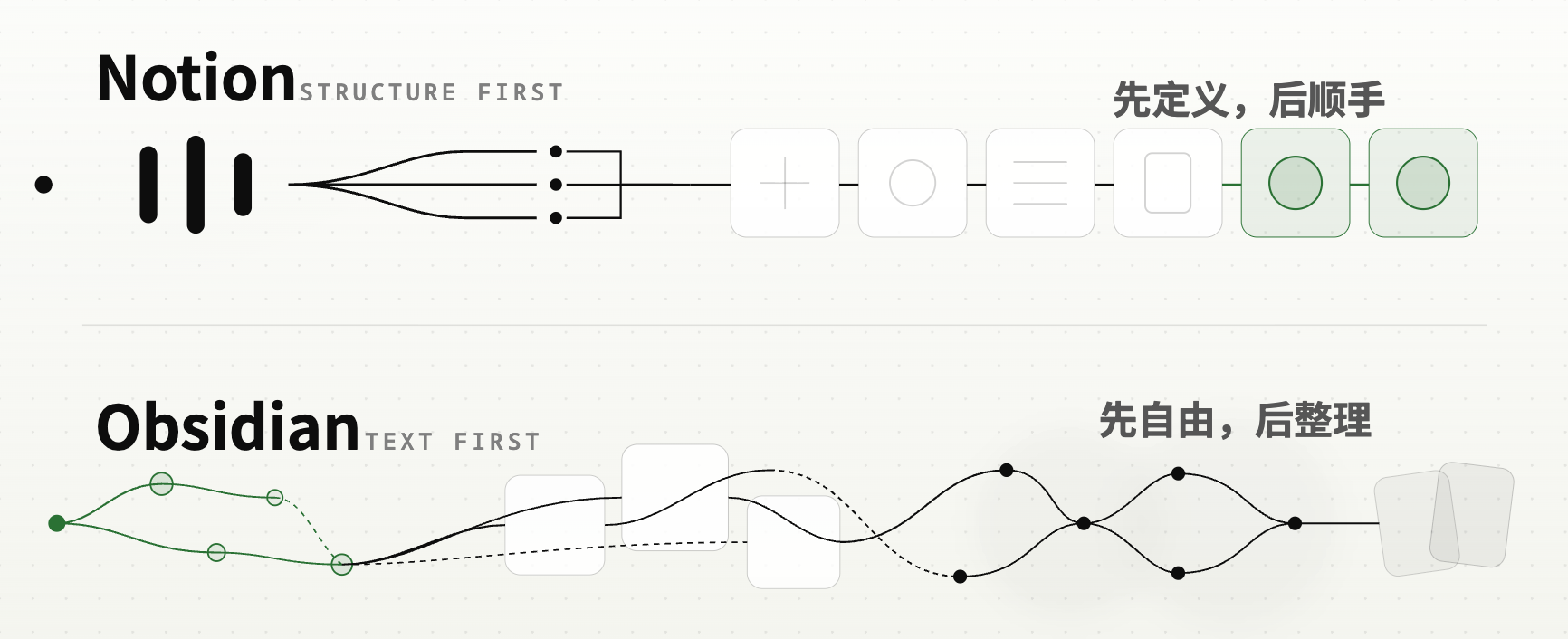
The atmosphere created by the product still matters. It affects whether each input leans toward structured expression, or toward a looser white-paper space where thoughts can spill out first.
Comparing feature by feature has limited value: who can build the stronger system, whose relations feel better, whose third-party tools are richer, whose migration path is easier, or whose AI models are stronger. They serve different people, and both are borrowing from each other. If you stay too deep inside one feature, the conclusion becomes shallow.
When AI Starts Taking Action
AI will gradually flatten the differences between the two products in surface abilities such as writing, search, summarization, and documentation. The larger gap appears when AI moves beyond Q&A and starts creating, deleting, editing, and querying your information. At that point, the experience depends on how each system defines operational objects and permission boundaries.
A task object with status, priority, owner, and deadline can be filtered, updated, or assigned by an agent with more precision. A plain text note with only a #task tag gives the agent less to work with. It can search, then make a fuzzy or open-ended judgment based on intent. The two will not behave the same when automation calls them.
So, in a slightly ambiguous way, Notion AI is better at getting things done, while Obsidian AI is better at resonating with you. At least for now.
When AI becomes a primary productivity tool, the note systems we built to improve retrieval efficiency start to feel less certain. If you need an old idea again in the future, an AI-generated reconstruction may not be worse than digging up a Markdown file from ten years ago.
The free will we were proud of, the real thinking written into notes, and the diary-like sense of being alive may not retain the same value in front of stronger AI. I am pessimistic about this.
If AI becomes strong enough, both Obsidian's long-term readability and Notion's structured retrieval will need to be re-evaluated.
The Answer Still Matters Now
At least today, AI is not strong enough to make information architecture unnecessary. Your note system is still the infrastructure for working with AI, so it is still worth spending time on this choice.
AI models may change every few weeks or months, so you do not need a decision that can last ten years. It is enough to ask what problems you need to solve now, and at most within the next year.
If information needs to enter concrete workflows and collaboration after you write it down, Notion has the advantage over Obsidian, and AI can produce more precise execution results there. The risk is premature definition. You may classify, add fields, and build processes before an idea is mature, then end up maintaining the system for its own sake. A bad Notion system only creates deeper paths and more polished confusion.
If information matters more for long-term preservation, repeated association, slow development, or future reinterpretation, Obsidian fits better, and AI may bring more unexpected connections. Its risk is delayed organization. Structured information needs to be constrained through text and third-party plugins, so the freedom you gain early can return later as messy naming, loose links, and broken plugins. The FLO.W Obsidian template I am building aims to set up the structure for projects, tasks, notes, and reviews first, so you start with less of a blank vault. You can join the waitlist if that sounds useful.
With AI context windows still usually around 200K to 1M, you cannot expect AI to understand your entire system completely.
For now, the more you want AI to participate in execution, the more the system needs clear boundaries for identity, status, relationships, and permissions. This is similar to the SOUL, AGENT, USER, and MEMORY documents that OpenClaw has to maintain carefully. Longer context does not replace information structure itself.
Differences And Choices
Imagine two kinds of people. One is a project-oriented worker who is moving three to five things forward at the same time: a freelancer, a small team owner, or a department lead.
Each week, they switch between client needs, content schedules, payment tracking, asset libraries, and team communication. They are most afraid of missing something, forgetting to update a status, or losing track of a promise. They need information to gain a source and destination quickly, so attention can stop being spent on remembering everything.
The other person is writing a book or doing long-term research. They read dozens of pages every day and produce dozens of associations. Most will not be useful right away, but some may connect with another source late at night two years later. Their biggest fear is that an unfinished idea gets filed too early and then disappears.
To me, the first person fits Notion, and the second fits Obsidian.
Notion treats information as valuable once it enters a system and can be coordinated or executed. After something is written down, it needs to be named and classified quickly.
Obsidian treats information as valuable because it can still exist outside one specific system, so it prefers to keep information as text first.
The real difference is this: with AI in the picture, do you want knowledge to become part of an action system first, or remain as thought text that can be reorganized and reinterpreted? One day, you may not need to choose. At this stage, you still need to decide where you are more willing to pay the cost of organization.
Are you willing to define information early in exchange for clearer retrieval, collaboration, and execution later? Or are you willing to accept later naming, organization, and maintenance problems in exchange for a looser note-taking experience early on?
What are you missing more right now: the lightness of not organizing too early, or the order that helps ideas become action faster?
Both products can build large worlds, and both leave plenty of room for imagination. That makes it hard to want everything at once. If you have to choose, your instinctive answer to the question above is usually enough.
The shelf life of that answer will not be long. Do not think too far ahead, or do not rush to think about it at all. Give AI more time, and maybe the question will stop needing an answer.
Author

Categories
More Posts

Obsidian and Readwise Integration Tutorial: Clippings, Highlights, and Property Fields
Obsidian Readwise sync tutorial: plugin install, Readwise export settings, file naming, body formatting and YAML properties to sync highlights reliably.

Obsidian 2026 Plugin Installation Guide: Marketplace, BRAT, and Mobile
This guide explains the main sources of Obsidian plugins, how to install community plugins on desktop and mobile, and how to use BRAT for GitHub plugins.

Obsidian 2026 Latest iCloud Sync Tutorial: Step-by-Step Mac and iPhone Setup
This tutorial starts by creating the correct Obsidian iCloud folder on iPhone, then shows how to open the same Vault on Mac and iPhone and verify sync.